Lebanon: The Country the IMF Cannot Forecast
Why the International Monetary Fund has left Lebanon's growth projections blank through 2031
I have read many IMF tables over the years, but the latest one stopped me. In its October 2026 World Economic Outlook, the Fund gives growth forecasts through 2031 for almost every economy in the Middle East and North Africa. Lebanon gets one number, an estimated 4 percent real growth for 2025, and then nothing. The columns for 2026, 2027 and 2031 are empty.
The contrast with our neighbours is hard to ignore. Egypt is projected at 5.1 percent in 2026 and 4.8 percent in 2031. Jordan, Morocco and Tunisia all have figures. Even Sudan, at war with itself, is given a forecast of 7 percent for 2026, and Yemen is expected to return to positive growth of 2.5 percent by 2031. Lebanon shares its blank space with only a few cases, among them the West Bank and Gaza, Afghanistan and Syria. That is not company any Lebanese should be comfortable keeping. So the question has to be asked: how did we become so unpredictable that the IMF will not even guess?
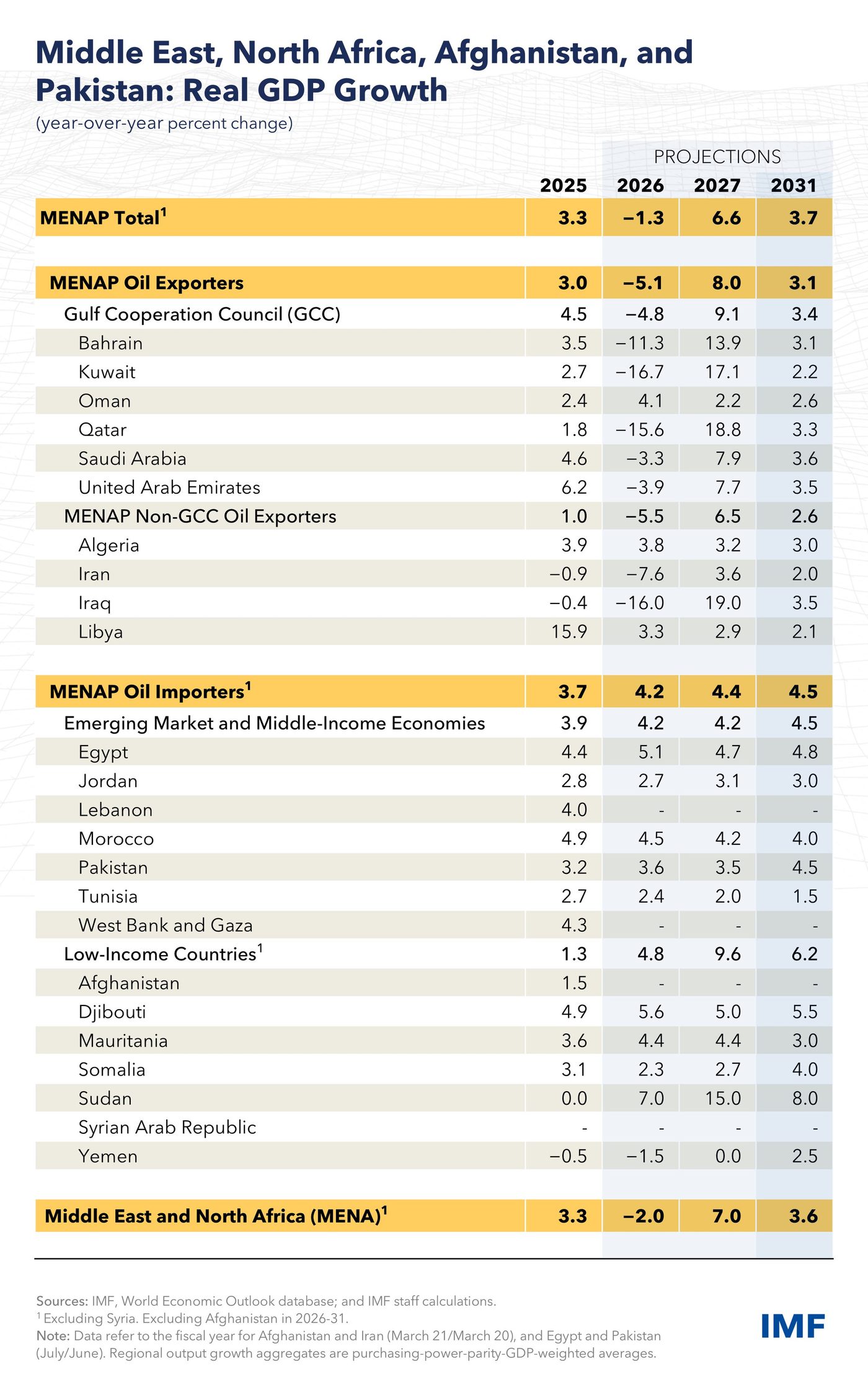
1. When the models stop working
The Fund itself says the omission reflects unusually high uncertainty. This is not a statement that Lebanon has no future. It means the assumptions any forecast depends on cannot be established with confidence. An economist projecting growth needs some reasonable view of monetary policy, public finances, investment conditions and political stability. In Lebanon, all four are in doubt at the same time. Since 2019 we have lived through the collapse of the banking sector, a sovereign default, a currency that lost most of its value, institutional paralysis and one security shock after another. No model is built for that.
2. The banks and the depositors
Seven years on, billions of dollars in deposits are still out of reach of the people who own them. Who should carry the losses — the state, the Banque du Liban, the commercial banks, their shareholders or the depositors — remains the most contested question in the country. As a lawyer, I would say it is also a question of justice, not only of accounting.
Until the banks are properly restructured, they cannot gather savings, lend to businesses or finance investment. The IMF has repeated the same points for years: restructure the banks, allocate the losses transparently, protect the legitimate rights of depositors and restore financial sustainability. An economy without functioning financial intermediation does not recover on a schedule anyone can predict.
3. War and a state still incomplete
The renewed conflict between Hezbollah and Israel, inside a wider regional confrontation, has damaged infrastructure, displaced families, disrupted trade and frightened off investors. Yet the deeper problem is that the basic conditions remain open questions. Will the hostilities end? Will reconstruction begin, and who will pay for it? Will investment come back? And, the question I consider decisive, will the Lebanese state exercise effective authority over all of its territory? Having served as Military Prosecutor, I know how much rests on that last point. No forecast can price in an answer the state itself has not yet given.
4. No credible plan for the long term
A medium-term projection assumes a coherent fiscal and economic strategy. Lebanon is still talking to the IMF, but it has not implemented a full reform framework that would restore debt sustainability, rebuild confidence in the banks and give investors predictable rules. The IMF staff mission of September 2026 welcomed progress on banking legislation and fiscal planning, while stressing that more is needed on deposit recovery, a credible budget and sustainable public finances. Without such a framework, any figure for 2031 would be speculation dressed up as economics.
5. Reading the blank columns correctly
The empty cells should not be read as a forecast of zero growth or of collapse. Lebanon still has real assets: a large and loyal diaspora, entrepreneurial people, a strong services sector, tourism and a private sector that has proved remarkably resilient. But potential is not a forecast. What the blank columns tell us is that our medium-term performance depends on political, financial and security decisions that have not yet been taken.
The real tragedy, in my view, is not that the IMF cannot predict Lebanon's future. It is that Lebanon has not yet created the conditions that would make that future predictable. Until we restore financial accountability, credible institutions, security and the rule of law, we will remain more than an economy in crisis; we will be an economy whose direction cannot even be measured. That may be the most worrying indicator of all.
Sources: International Monetary Fund, World Economic Outlook, October 2026, which states that Lebanon's projections for 2026–2031 are omitted owing to an unusually high degree of uncertainty; WEO October 2026 statistical appendix, which shows 2021 as the last year of actual annual government finance data for Lebanon; IMF staff mission concluding statement on Lebanon, 18 September 2026, documenting ongoing security, banking and fiscal challenges.
Also published on LinkedIn.