Do Israeli Sanctions Threaten Coral Oil's Legal Existence in the UK and Its Access to International Banking?
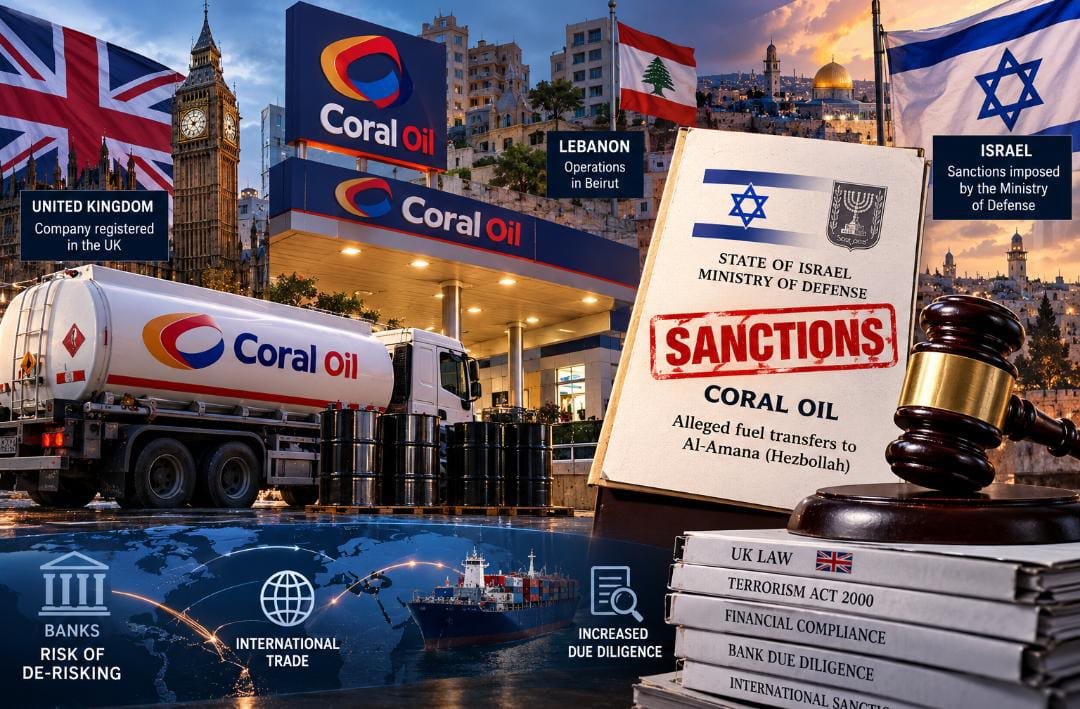
On 22 October 2026, Israel's Ministry of Defense, through its National Bureau for Counter Terror Financing (NBCTF), announced that Defense Minister Israel Katz had signed a measure against The Coral Oil Company Limited. The stated ground was the transfer during 2026 of some 130,000 litres of diesel and gasoline to Al-Amana, a fuel company designated by Israel as a terrorist organisation and described by Israel as owned by Hezbollah.
What makes this case notable is not the measure itself but the legal structure of its target: a company registered in the United Kingdom, owned by a Lebanese group, and operating in practice through its Lebanese branch. That raises what I see as the central question. Is the company's legal existence in Britain at risk, or are we facing a quieter but more consequential risk, namely the banking risk?
1. The nature and limits of the Israeli measure
The label matters before we build on it. What the NBCTF published is an Administrative Seizure Order, ASO 33/26, issued on 22 October 2026 and valid until 21 October 2028, whose object is the stated quantity of fuel (130,000 litres). The media have called it "sanctions", a convenient term but not a precise one.
The measure falls under Israel's Counter-Terrorism Law of 2016, which empowers the Defense Minister to designate terrorist organisations and take administrative measures against related funds and property. Al-Amana itself is designated by the NBCTF under that law, with a permanent designation dated 27 June 2020, on the basis of its links to Atlas Holding, owned by the Martyrs Foundation.
More importantly, in my assessment, the direct legal effect of any Israeli measure is, in principle, confined to Israeli jurisdiction. Lebanese law does not recognise it, and British law does not require its enforcement. Its real weight lies not in enforceability but in the risk signal it places into the compliance files of banks and financial institutions worldwide.
2. The company's British legal personality
Companies House records show the company registered under number 00203333 as CORAL OIL COMPANY LIMITED (THE). It was incorporated on 24 January 1925 as Shell Company of Syria Limited, is listed as Active, has its registered office in London, and declares its business as wholesale of fuels.
As a matter of principle, no foreign measure, Israeli or otherwise, can extinguish the legal existence of a British company. Corporate personality is acquired and lost under British law alone, through British procedures. Talk of a "threat to its legal existence" should therefore be read in the indirect sense: the possibility that the Israeli measure becomes the starting point of British scrutiny, not a free-standing cause of dissolution.
3. Exposure under the UK Terrorism Act 2000
This is where the file becomes sensitive. Hezbollah has been proscribed in its entirety in the UK since 2019, and the Terrorism Act 2000 contains three core financing offences.
Section 15 covers fund-raising: inviting, receiving or providing money or other property, knowing or having reasonable cause to suspect that it may be used for the purposes of terrorism. Section 17 covers funding arrangements: entering into or becoming concerned in an arrangement by which money or other property is made available to another, knowing or having reasonable cause to suspect that it will or may be used for the purposes of terrorism. Section 18 covers money laundering: facilitating the retention or control of terrorist property, by concealment, transfer or otherwise.
Section 63 extends jurisdiction: an act done outside the UK is an offence if it would have constituted an offence under sections 15 to 18 had it been done in the UK.
I see section 17 as the provision most relevant here. Fuel is "property", and "reasonable cause to suspect" is an objective test that does not require actual knowledge. Fairness, however, requires a reminder that any offence must be proven before a British court under British rules of evidence; an Israeli allegation is not, in itself, evidence. To date, as far as publicly available information goes, no British investigation has been announced.
4. The Al-Amana precedent and conflicting accounts
The file cannot be read without its history. On 26 February 2020, the US Treasury's OFAC designated Amana Fuel Co. as a Specially Designated Global Terrorist under Executive Order 13224, as owned or controlled by Atlas Holding, itself linked to the Martyrs Foundation.
Coral Oil, for its part, published a statement on 13 July 2021 responding to similar allegations. It stated that it suspended its commercial dealings with Al-Amana on 29 February 2020, three days after the US designation, removed its branding from the stations concerned, and engaged with the US and UK embassies to demonstrate compliance. The company and its owners denied any link to Hezbollah.
We therefore have two conflicting accounts: an Israeli one alleging transfers during 2026, and the company's official position that the relationship ended in February 2020. That contradiction is exactly what any bank compliance department will focus on, not as a prejudgment, but as a matter of enhanced due diligence.
5. Implications in Lebanon, legal and financial
In Lebanon, an Israeli measure has no legal effect. But Law No. 44 of 24 November 2015 on Fighting Money Laundering and Terrorist Financing establishes, in Article 6, the Special Investigation Commission at Banque du Liban as an independent body of judicial character, empowered to investigate suspicious operations, impose temporary precautionary freezes, and decide on final freezing and the lifting of banking secrecy in favour of the competent judicial authorities.
In my view, the significance of Article 6 is not that the SIC would act on an Israeli measure, which is legally and politically unlikely, but that foreign correspondent banks will ask Lebanese banks about this company, and the SIC is the authority that answers, or should answer, those questions.
Nor is this file read in a vacuum. Lebanon has been on the FATF list of jurisdictions under increased monitoring, the so-called grey list, since October 2024, and the FATF kept it there in its statement of 19 June 2026, pending its next review. In its October 2026 World Economic Outlook, the IMF published growth projections for the region's economies, from Egypt and Jordan to Morocco and Tunisia, but omitted Lebanon from its projections for 2026 onwards, giving only an estimate for 2025 and citing an unusually high degree of uncertainty. The World Bank, in its August 2026 report, projects that Lebanon's economy will contract by 6.4 percent this year, after estimated growth of 4.2 percent in 2025. A grey-listed country, a contracting economy, and an absence from the projection tables: that is the environment in which any banking relationship with a company operating in Lebanon will be assessed, and it is an environment Lebanon has so far failed to improve in any lasting way.
6. The real risk: access to international banking
My conclusion is that the real risk to Coral Oil lies not in the UK companies register but in the international banking system. Banks do not wait for court judgments before exiting relationships; they work on a risk basis. When one file combines a London-registered company, the Lebanese fuel sector, and a foreign counter-terror-financing measure linking it to a US-designated entity, the likely response ranges from enhanced due diligence and requests for documentation to, in the extreme case, de-risking and termination of the relationship.
The irony is that the FATF itself states, in its grey-list publication, that its standards do not envisage cutting off entire classes of customers but call for a risk-based approach. Banking practice, however, often moves faster than that distinction.
The impact goes beyond the company itself. Import letters of credit, cargo financing and dollar transfers through correspondent banks all pass through institutions that will not carry the cost of doubt. In an already fragile Lebanese fuel market, that is not a technical detail.
7. Should the company take preventive steps in the UK?
My answer is yes, provided the point is understood precisely. What is called for is not an admission of any liability, but preventive risk management undertaken by the company itself before the banks impose it. In my view, these steps rest on five foundations.
First, a ready compliance file. An enhanced, up-to-date KYC pack setting out the ownership structure, beneficial owners and screening policies, offered to UK and correspondent banks before they ask for it. Taking the initiative reduces the weight of suspicion more than any later response.
Second, clean records at Companies House. Obligations relating to Persons with Significant Control under Part 21A of the Companies Act 2006, and routine filings, are ordinary duties of every British company; but in circumstances like these, any gap becomes a ready reason for deeper scrutiny. To this should be added regular, documented screening of customers and distributors against applicable sanctions lists.
Third, a legal opinion from specialist UK counsel. Assessing exposure under sections 15, 17 and 18 of the Terrorism Act 2000, and under the jurisdictional rule in section 63, is a technical matter that press statements cannot settle. Section 19 of the same Act also imposes a disclosure duty in defined circumstances concerning information that comes to a person in the course of business, and whether that duty has any application in a given case is for counsel to judge, not for internal administrative improvisation.
Fourth, documenting the 2020 termination with Al-Amana. The company's statement refers to ending its dealings on 29 February 2020. That termination, together with evidence that supplies actually stopped from that date, should be documented and available to any correspondent bank that asks, and supplemented with facts that rebut the 2026 allegation.
Fifth, careful engagement with UK authorities, through counsel. UK law provides mechanisms for disclosure to the National Crime Agency, including the prior-disclosure-and-consent mechanism in section 21ZA of the Terrorism Act. I do not see this as a duty arising for the company merely because an Israeli measure has been issued, but it is an option to be considered with counsel if the facts require it. The same applies to the Office of Financial Sanctions Implementation (OFSI), which becomes relevant only if a link to names on UK sanctions lists arises.
In this sense, preventive action becomes the company's own de-risking: it protects its banking access and places it in the position of the party that holds the facts, not the party asked to justify them.
Conclusion
The answer to the question in the title requires a distinction. Coral Oil's legal existence in the UK is not directly threatened by the Israeli measure, because that existence can only be removed under British law. Its access to international banking, however, is the weakest link, and that is where files like this are actually decided, particularly when the company operates from a grey-listed country whose economy is contracting.
In my view, the company has one effective path: documented transparency. That means proving, with documents, the date on which the relationship with Al-Amana ended; answering the 2026 allegation with facts rather than statements; and using whatever avenues of challenge are available. In financial compliance, being innocent is not enough. You must be able to prove it, and quickly.
Sources
1. Israel Ministry of Defense, NBCTF, ASO 33/26 (22 October 2026): https://matal.mod.gov.il/en/seizure-and-forfeiture-orders/aso-3326/
2. NBCTF, Al-Amanah Company designation: https://matal.mod.gov.il/en/organizations/alamanah-company-no80/
3. The Jerusalem Post, 22 October 2026: https://www.jpost.com/israel-news/article-912601
4. Companies House, company 00203333: https://find-and-update.company-information.service.gov.uk/company/00203333
5. Terrorism Act 2000 (ss 15, 17, 18, 19, 21ZA, 63): https://www.legislation.gov.uk/ukpga/2000/11
6. US Treasury press release, 26 February 2020: https://home.treasury.gov/news/press-releases/sm917
7. Coral Oil statement, 13 July 2021: https://www.coraloil.com/respond-to-false-al-amana-allegations/
8. Lebanese Law No. 44/2015, Article 6: https://sic.gov.lb/sites/default/files/laws-regulations/Law%2044%20Ar.pdf
9. FATF, Jurisdictions under Increased Monitoring, 19 June 2026: https://www.fatf-gafi.org/en/publications/High-risk-and-other-monitored-jurisdictions/increased-monitoring-june-2026.html
10. IMF, World Economic Outlook, October 2026.
11. World Bank, Lebanon Economic Monitor, August 2026: https://www.worldbank.org/en/news/press-release/2026/08/21/renewed-conflict-derails-lebanon-s-fragile-economic-recovery